25 April, 2013

Blog 21: Independent Component 2

Literal:

A)I, Jared Gonzales, affirm that I completed my independent component which represents 30 hours of work.
B)Baldwin Park Police Explorers
C) Hours Log
D) Since the last independent component, I have graduated into becoming a full fledged police explorer, have gone to competition where I tested everything I have learned in my classes against other police explorers, and I have been attending meetings at my Police Explorer post and furthering my education on law enforcement through the program. I have also used my mentorship to help me explore different answers and activities that I can use for my final 2 hour presentation. Competition was a great area for me to do mock tests of how an officer can best handle life threatening situations since a lot of scenarios involved that very thing. On top of this, I have done details for my post.

Interpretive: 

Having now graduated police explorer academy, I am now a full fledged police explorer. I got to take part in a nationwide competition at Chandler, Arizona that police posts from all over the country come to compete in. I participated in multiple scenarios where there were live actors, the scenarios were replicas of past events that have actually happened, and the whole thing was made to be as realistic as possible. I was in charge of a hostage negotiations scenario where I had to talk down a high school student with a gun who had multiple hostages and had shot a few already. Competition was one of the most significant moments of my senior project as it gave me a means to test out ways an officer can best handle a life threatening situation. As a result I was able to come up with the answers I have now.


One of the scenarios at Chandler, Arizona

Some of the competitions were those of strength and teamwork.
While others looked at critical thinking and communication.
The type of events were very varied, but teamwork was necessary in all.
A team about to breach a building in a 10 man hostage rescue scenario.
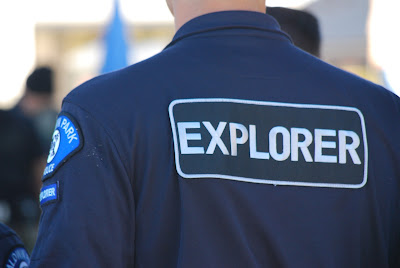
Explorer Sgt from my Post.
Shooting competitions were a large part of the Chandler competition.
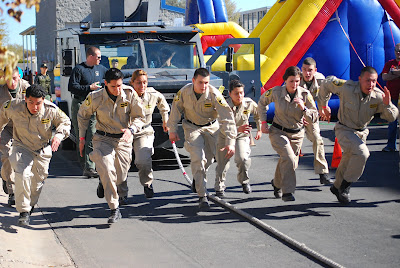
Having to pull a swat vehicle was a challenging event.

A lot of the events had professional actors as criminals. 
Making them seem almost like the real thing.
In the end, Baldwin Park came away with a lot of trophies.

Applied:

As I stated above, this component really helped me narrow done my answers for my EQ since I got to test their actual application in the field. I quickly discovered that my explorer training practically saved me in the scenarios meant to be life threatening (answer # 1), that being able to effectively communicate with not only my partners but with suspects and fellow agencies was almost essential (answer # 2), and that understanding how everything from my radio to my handcuffs worked meant that I wasn't struggling with them while under fire (airsoft bb's and paintballs) and thus I was able to concentrate on staying in one piece during competition (answer # 3). 


06 March, 2013

Blog 19: Senior Project and ESLRs


1.  What ESLR have you excelled in most in your senior project? 
  • Effective I-Poly Citizen
2.  Please explain why you think you have excelled in this ESLR.
  • Not only have I met the requirements for the number of service learning hours needed, but have more than triple what was asked for. My entire senior project mentorship, being a police explorer, revolves around community service. From working the Rose Bowl to working at Christmas charity events for the less fortunate of my city, I have done much to give back. Through my time at the academy for my mentorship, I have learned the importance of deadlines, being punctual, and always being respectful. 
3.  Provide evidence from your senior project to support your claim (evidence is a photo of something you are doing, photo of something you made, etc).


28 February, 2013

Blog 18: 2 Hour Meeting Answer 3

1) How can an officer best handle a life-threatening situation?

2) The proper and efficient use of police equipment will keep an officer out of harm's way.

3)

  • Knowing how your equipment works, from radios to your service weapon, will protect you from danger since that is one of their purposes. 
  • Anything an officer carries on him is meant to help him and victims, so the greater amount of knowledge they have on each will allow them to use their equipment more effectively.
  • Today's criminals are becoming more dangerous as they aquire more powerful tools of destruction, so any advantage over them must always be used, and in this case that is the proper and efficient use of police equipment.
4) Mentor: Officer Jaycon Sanchez

5) I plan to get more experience with all the police equipment at my disposal at my mentorship. This ranges from becoming more proficient with radios and radio codes to knowing how to perform first aid and CPR. My test to see how effective improved knowledge with such things will be an evaluation on how much they help me out on my ride alongs with the officers. 

21 February, 2013

Blog 17: Fourth Interview Questions

1) How can an officer best handle a life-threatening situation?
2) Would you say that good communication skills is a key part of law enforcement?
3) How important would you say that effective communications is?
4) Can you tell me of a time when communcation helped you out in a situation?
5) Can you tell me how to improve on the type of communcation skills you use as an officer?
6) In your opinion what is essential to handling a life-threatening situation, your training from the academy or effective communications? Why?
7) Besides good communications and utilization of academy training, what would you say is essential to an officer handling a life threatening situation and why?
8) How often do you encounter a situation where better communication could have completely changed the outcome?
9) What is effective communications to you as a police officer?
10) Do you believe that being skilled in the equipment that is given to you as an officer is essential to handling a life threatening situation? Why?
11) Where would you say that that skill in proper use of your equipment comes from?
12) How does one improve in becoming more efficient in use of police equipment?
13) Can you tell me of a time where proper use of police equipment saved someones life or kept a situation from becoming worse?
14) Between inadequete training in equipment, poor communication skills, and ineffective use of training, what places the officer most in danger?
15) What would you say is the most difficult type of person for an officer to communicate with?
16) Besides the officer, who else would you say benefits from an officer who can communicate well?
17) In your opinion, what would you say gets officers in the most trouble as far as a situation and why?
18) Would you say its accidental or something that some officers are more prone to?
19) For the officers that are prone to these type of situations due to their habit or nature, how would you assist them in fixing that?
20) What is the first thing and the most key thing you do that helps you analyze a life threatening situation before and as it transpires?

06 February, 2013

Blog 16: 2-Hour Meeting Answer # 2

1) How can an officer best handle a life-threatening situation?

2) Effective communication with fellow officers will best help an officer handle a life-threatening situation.

3)
  • Communication is key to teamwork with your partners in the field.
  • Effective communication neccessary to working with other police departments, especially in large scale operations.
  • Proper relay of orders to suspects can cause them to surrender peacefully.

4) My time at the STARS academy and at my post have given me insight into making this one of my answers.

5) I plan to continue my study of answer 2 by doing in the field work with my post and analyzing how to make communication the most effective.

03 February, 2013

Blog 15: Independent Component 2 Approval

1) Being that communication, especially teamwork, with your partners is essential to handling a life-threatening situation, I plan on exploring how to make that more effective. Sometimes you will have to work with members of other departments whom you have never interacted with before, so learning how to overcome this barrier is key to saving lives. I plan on doing this by improving the communication I have with the partners at my post as we practice scenarios. The other part will be done by working with the new applicants we have at our post by exploring how to convey orders to the unfamiliar in a way that works best.

2) My post meets for 5 hours every other Wednesday, but sometimes we will move to every Wednesday depending on everyones schedule. We also work weekend details for varying hours. At that rate I will be done fairly soon.

3) As stated before, effective communications is essential to handling a life-threatening situation, and by exploring it I will definitely find an answer to my EQ.

01 February, 2013

Blog 14: Independent Component 1

Literal
a) I, Jared Gonzales, affirm that I completed my independent component which represents 30 hours of work.
b) Officer Jaycon Sanchez
(626)827-3746
c) Mentorship Log
d) Completed my 18 week training at the Sheriff's Training and Regional Services Explorer Academy, attended my weekly meetings at Baldwin Park PD Explorer Post # 654, worked 2 events (a Christmas event and the Rose Bowl), and went to my first competition at Chandler, Arizona.

Interpretive
For my 18 week program, I would have to wake up at 4:00 A.M. to make it to class at 6:00 A.M. and it would last all the way until 5:00 P.M. The program was not easy in any way easy to complete and required me to sacrifice 18 weekends, yet in the end it was worth it. On top of this, I had to attend my weekly meetings on Wednesdays which lasted 4-5 hours. At these meetings I would physically train for half the time with my post and then we would spend the rest of the time practicing for competition at Chandler, Arizona. All my work came together in one weekend (January 19-21) when I graduated from the academy and then immediately traveled to Chandler to compete.

 Day 1 at the Academy
 Day 1 at the Academy
 Me getting my head shaved.
 Teambuilding activity.
 Classroom time.
Colors Run.
Personal Defense Training.
Firearms Training.
CPR Training
Getting thrashed by the Drill Instructors.
My graduating class.


Applied
Since my Independent Component was training exactly mimicking that actually given to deputies, it was the best possible foundational work for my topic of law enforcement. It not only taught me facts and information, but also prepared me physically and ultimately gave me the officer's perspective. Everything from the drill formations, to the physical training and runs, the classroom work, the firearms training and CPR, and the hands on police scenario's has given me an indepth look at law enforcement usually reserved just for those who attend the actual academy and graduate.

15 January, 2013

Blog 12: Third Interview Questions

How can an officer best handle a life-threatening situation?

What skills, traits, or experience help keep an officer calm during an emergency?

What are some of the most deadly emergencies that an officer can face while in the line of duty?

What type of training, if any, does the police academy offer to prepare trainees for future service?

What are the dangers of not being able to keep calm during an emergency?

How often would you say you hear of or witness an officer who isn't prepared to respond to emergencies?

Do you know of any special techniques used to keep calm during emergencies, and if so what are they?

Do you believe that the ability to keep calm during an emergency can be taught? Why or why not?

What is the best way to prepare to handle an emergency?

What kind of mentality do you need to effectively and calmly handle an emergency?

What has worked the best for you in your experience?

10 January, 2013

Blog 11: Mentorship 10 hours Check

1. Where are you doing your mentorship?

  • I am still enrolled but about to graduate from the Los Angeles County Sheriff's Training and Regional Services Center Explorer Academy. My mentorship is going to be continued at my Police Explorer post at the Baldwin Park Police Department. 
2. Who is your contact?
  • I am about to graduate and become an explorer at the Baldwin Park PD Explorer Post and my primary mentor is Officer Jaycon Sanchez. 
3. How many total hours have you done?
  • Not counting summer hours, up until 1/10/2013 I have 255 hours from my explorer academy, weekly post meetings, and any events I worked. My total overall is 299 and a half hours if I include summer.
4. Summarize the 10 hours of service you did.
  • The 255 hours I have accumulated are the result of my 18 week explorer academy, my weekly post meetings, and the 2 police details I have worked so far.  The 18 week explorer academy comprised of physical training and in class training in preparation for my duties as a police explorer. My weekly post meetings were a furthering of this while also serving as training for the competition I am going to on the 19th of this month. The 2 details included the Christmas event for Baldwin Park's youth and the traffic detail I worked at the Rose Parade and Rose Bowl game. 

02 January, 2013

Rose Parade/Rose Bowl - January 1st 2013

On Wednesday, January 1st, I got to work my 2nd official detail as an Explorer at the Rose Parade and Rose Bowl. My post was assigned to traffic duty, where we basically were each given a street to manage and keep traffic moving and allowing pedestrians to cross as they moved from the parade and to the game.


Rose Bowl before the game.
File:Traffic police I.JPG
This is basically what I was doing for 5 hours. I quickly learned
that it is not a lot of fun, especially when dealing with
unruly fans and angry drivers.

Final "Real" day at the Academy - December 29th


Saturday, December 29th, was the last day we, as recruits, would have any formal training or lectures. We had our Final Exams, our Final Physical Training 500 exams, and our final lecture on Patrol Procedures.

Despite having 3 more Saturday meetings to go, the reason why this one is considered the last is because the next three meetings are devoted to Family Day (sort of an open house for our families to see what we've had to go through) and then Graduation rehearsal, and finally Graduation day.

 I am so happy to have made it this far and am looking forward to finally becoming an Explorer.


Final Defense Tactics Training - December 22nd


Saturday, December 22nd, was the final day where we were taught maneuvers on how to catch, fight, and take down a hostile suspect. We were tested on all of the information we had been given at the end of the day by having to use it in a real hands on scenario. 

The scenario entailed the following:
  1. I and a partner had to arrive on the "scene" in a police cruiser, give out the proper radio and location information, and then proceed to run to the building where the suspects were.
  2. While warming up for the scenario, we had to punch and kick punching bags and do push ups while continuing to relay information on where we were located at.
  3. We did a few minutes of jump rope and push ups to keep our blood going while we waited our turn for the final stage of the scenario.
  4. The last and best part had us fighting a fully padded up Drill Instructor with the intention of taking him down and arresting him. If it seemed like we were winning, more Drill Instructors would be thrown into the fight. Mind you, most of them are former Marines or army, and all of them are currently on duty as a deputy or officer and have much more experience on us. 
All in all I learned a lot from today, and it definitely will be a day I remember. 


10 December, 2012

Sheriff's Shooting Range!

On Saturday, December 8th, my academy class went to the L.A. County's Sheriff's Range in Valencia for a private lecture, demonstration, and opportunity to fire the department's weapons. While I am not at liberty to disclose the full details of what went on, I can say that it was definitely a fun experience. We were able to take home the brass and shells of the shots we fired. At the end of the day, I was informed that I was to be the next class sergeant for my academy class.